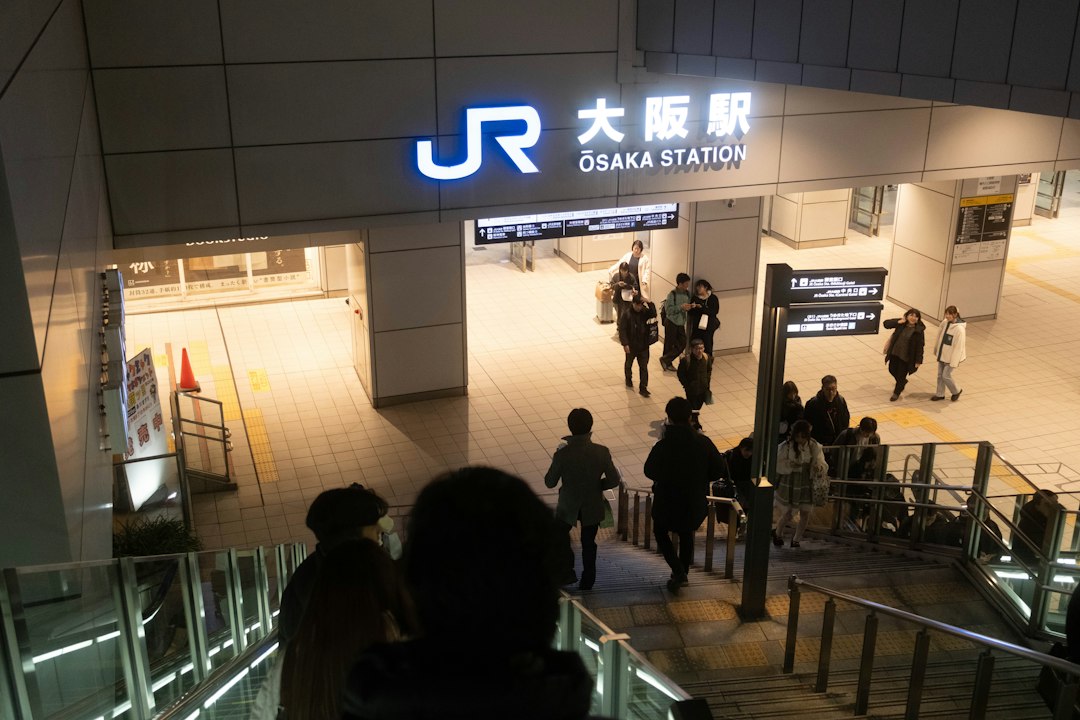
If you’re arriving in Osaka between December 30, 2026 and January 3, 2027, do not plan your transfer through the JR Osaka Station central concourse — it’s the single worst bottleneck in the city during hatsumode season, and JR West itself has quietly rerouted its own staff announcements around it for years. The good news is that Osaka has five separate railway networks (JR, Osaka Metro, Hankyu, Hanshin, Keihan, Nankai) converging on the same few blocks of Umeda/Kita, and almost every JR route through Osaka Station has a parallel private-line or underground alternative that stays under the radar of most tourists.
Why Osaka Station Specifically Becomes a Chokepoint
Osaka Station (and the connected Umeda Station network) moves roughly 440,000 passengers a day on JR West lines alone in normal conditions. Between Dec 31 and Jan 3, that number spikes because three of Kansai’s biggest hatsumode destinations — Sumiyoshi Taisha, Osaka Tenmangu, and Imamiya Ebisu Shrine — all funnel visitors through central Osaka transfer points, and a large share of inbound travelers from Kyoto, Kobe, and the airport also pass through the same JR Kyoto Line / Kobe Line platforms at Osaka Station. On the night of Dec 31 into the early hours of Jan 1, the JR concourse between the Midosuji exit and the Central exit becomes genuinely difficult to move through with luggage — I’ve stood in that crowd at 11:40pm on Dec 31 and it took almost 20 minutes just to reach the Osaka Metro stairwell, a walk that normally takes 90 seconds.
Route 1: Skip JR Osaka Entirely — Use Hankyu Umeda for Kyoto, Kobe, and Takarazuka
Hankyu Umeda Station is a completely separate building about 400 meters north of JR Osaka Station, connected via the Hankyu Sanbangai underground mall. If you’re heading to Kyoto, take the Hankyu Kyoto Line limited express from Hankyu Umeda to Kawaramachi Station — it’s 43 minutes, costs around ¥410 one-way (2026 fare), and the platforms rarely see the density JR gets because tourists default to the JR Special Rapid. For Kobe, the Hankyu Kobe Line limited express runs Umeda to Sannomiya in about 27 minutes for roughly ¥330. Both lines run from separate, wide platforms on the 3rd floor of the Hankyu Umeda building, nowhere near the JR crowd funnel.
Route 2: The Underground Bypass — JR Tozai Line via Kitashinchi Station
Few visitors realize that JR Osaka Station has an underground sister station called Kitashinchi, reachable via the Diamor Osaka underground shopping mall in about 3-4 minutes on foot from the main JR ticket gates. Kitashinchi serves the JR Tozai Line, which connects toward Kyobashi and onward to Katamachi/Gakkenshi Line destinations, and during peak hatsumode hours it is dramatically quieter than the surface-level platforms because most New Year travelers don’t know it exists. If your destination is reachable via Kyobashi (for example, transferring to the Keihan Line toward Hirakata or Kyoto’s Chushojima), this is worth the extra five minutes of walking through Diamor Osaka’s basement food court.
Route 3: Osaka Metro Workaround via Nishi-Umeda and Higashi-Umeda
Instead of fighting through the main JR-to-Midosuji Line transfer stairs at Osaka Station, use the Yotsubashi Line’s Nishi-Umeda Station or the Tanimachi Line’s Higashi-Umeda Station. Both are roughly 300-500 meters from JR Osaka Station via underground passages but have their own separate ticket gates and far shorter queues on Dec 31-Jan 3. If your hatsumode destination is Osaka Tenmangu, get off at Minami-Morimachi Station on the Tanimachi Line (reachable directly from Higashi-Umeda, 3 stops, about 6 minutes) and walk 5 minutes to the shrine — this avoids the JR Loop Line’s Osaka Tenmangu-guchi exit entirely, which gets severely congested after 10pm on Dec 31.
Route 4: Heading to Namba or Shinsaibashi? Board Midosuji Line at Shin-Osaka Instead
If your onward destination after arriving at Shin-Osaka Shinkansen Station is Namba, Shinsaibashi, or Imamiya Ebisu Shrine, do not transfer at Osaka Station at all. Stay on the Osaka Metro Midosuji Line directly from Shin-Osaka Station — it runs straight through to Namba in about 17 minutes for ¥280 (IC card fare), and you never touch the JR Osaka Station platforms. This single decision eliminates the worst transfer point in your entire journey.
Route 5: Kansai Airport Transfers — Nankai from Namba Beats JR Haruka on Dec 30-Jan 3
The JR Haruka limited express from Shin-Osaka or Tennoji to Kansai Airport requires reserved seating, and during the New Year period those reserved cars sell out days in advance while the platforms fill with oversized luggage. The Nankai Electric Railway’s Rapi:t limited express from Namba Station runs every 30 minutes, takes about 39 minutes to Kansai Airport, costs around ¥1,450 one-way, and — critically — has far more capacity for unreserved standing/luggage space on the regular Nankai Airport Express (¥970, about 45 minutes) if you can’t get a Rapi:t seat. Namba Station itself is also less chaotic than Shin-Osaka during peak New Year travel days because it isn’t a Shinkansen interchange.
Special Overnight Trains on New Year’s Eve (Gantan Unten)
Osaka Metro typically runs all-night service on the Midosuji Line and Chuo Line on the night of December 31 into the early morning of January 1, with trains roughly every 15-20 minutes between 1am and 5am instead of the usual overnight shutdown. JR West has historically run limited late-night extra services on the Loop Line and Kyoto Line for the same window. Schedules for the 2026-2027 season are usually confirmed by Osaka Metro and JR West around early December, so check the official Osaka Metro website (osakametro.co.jp) and JR West’s Kansai area notices in the first week of December 2026 rather than relying on last year’s timetable, since exact hours shift slightly each year.
Cold Weather and Practical Logistics
Underground transfer corridors like Diamor Osaka and Hankyu Sanbangai are heated, which matters if you’re waiting out a transfer with kids or elderly relatives — surface-level JR platforms at Osaka Station have no wind protection and temperatures on Dec 31 night commonly drop to 2-4°C. If you’re carrying suitcases for a multi-city itinerary, use a coin locker at Shin-Osaka or Namba (sizes from ¥400 to ¥700 for 2026 rates) before tackling shrine visits, since none of these alternative routes have the elevator capacity to handle large luggage during peak crowd hours — you’ll be on stairs more often than on JR’s escalator-heavy main concourse.
One Thing Most Guides Won’t Tell You
These alternative routes only help if your IC card is already loaded and working — ticket machines at Hankyu Umeda, Nankai Namba, and the Osaka Metro gates all get long lines of their own on Dec 31-Jan 3 as travelers top up cards or buy paper tickets. As of 2026, mobile Suica and Pasmo work on foreign-issued iPhones via Apple Pay and are accepted across all five networks mentioned here, including Hankyu, Hanshin, Keihan, and Nankai, so load your balance the day before — not in the queue at Umeda on New Year’s Eve itself.
Photo by Harman Tatla on Unsplash