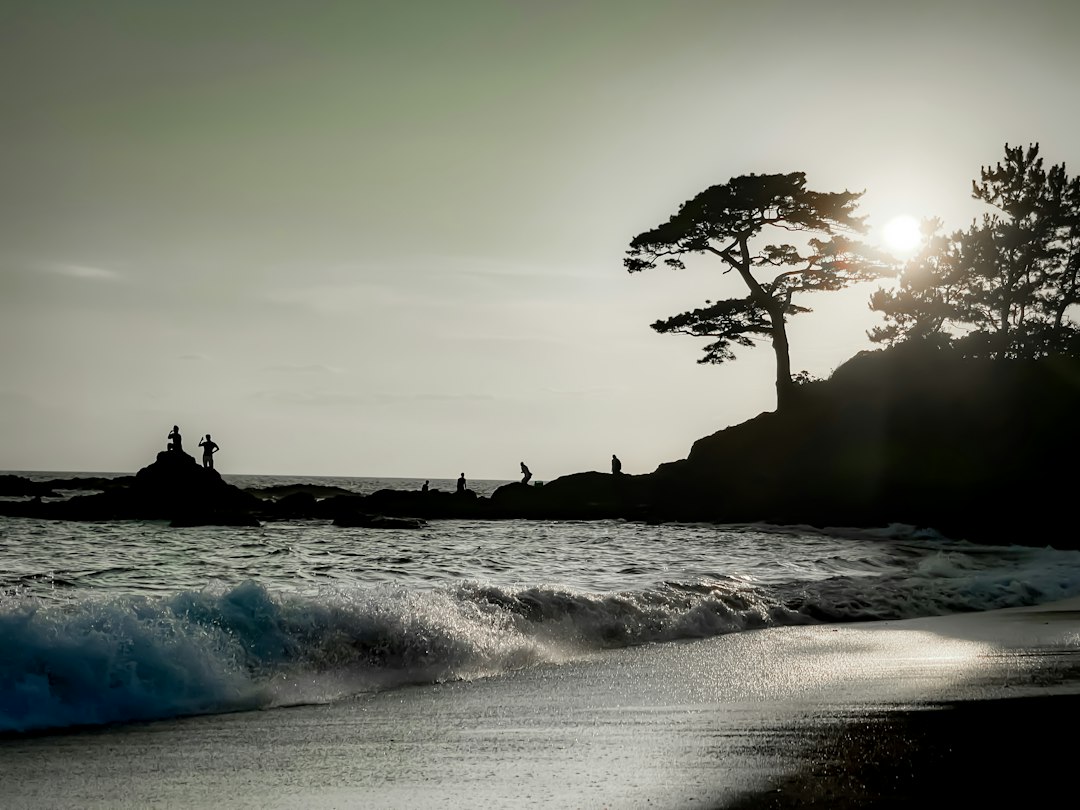
Why the Japan Sea Side Behaves Differently From Pacific Sunset Spots
The Japan Sea coast faces almost due west along most of its length, so unlike the Pacific side where you often have to chase a headland or climb a hill to catch the sun dropping into open water, here it just happens in front of you from the beach, the harbor wall, or the ryokan balcony. The catch is cloud cover: from late November through February, Siberian monsoon clouds roll across the sea and swallow the horizon on maybe two nights out of three, so locals in Fukui and Shimane will tell you the reliable sunset season runs April to early October, with August and September giving the clearest, latest (around 18:30-19:00) drops below the horizon. I’m listing five towns here that I’ve actually walked through at dusk, with the transit details and yen amounts you’d actually need.
Tojinbo, Fukui: Basalt Cliffs and the Classic Postcard Shot
Tojinbo is the one every Japan Sea sunset list leads with, and it earns it. The 1-kilometer stretch of andesite columnar cliffs drops 20 meters straight into the water, and from the viewing platform near Tojinbo Tower the sun sets almost directly over the sea in summer. Getting there: from Fukui Station take the Echizen Railway Mikuni Awara Line to Mikuni Station (about 25 minutes, roughly 760 yen), then a Keifuku bus bound for Tojinbo (about 10 minutes, 300 yen). The sightseeing boats (Tojinbo Sightseeing Cruise, around 1,500 yen for a 30-minute loop) usually stop running before the actual sunset in shoulder season, so if you want the sun-in-the-water shot, skip the boat and walk out onto the rock shelf itself — just mind the tide line, the rock gets slick. Tojinbo Tower (entry 500 yen, open roughly 8:30-17:00, later in summer) gives an elevated view if the rocks are crowded, which they often are on weekends.
Inasa Beach, Izumo: Where Shimane’s Mythology Meets the Horizon
Inasa no Hama is the beach where, according to the Izumo Taisha myth cycle, the gods of Japan are said to come ashore every October (Kamiarizuki, the “month with gods”). Visually what makes it worth the detour is Bentenjima, a small rock islet with a torii gate perched on top, standing maybe 200 meters offshore — at low tide you can walk partway out on exposed sand, and at sunset the torii silhouette lines up almost exactly with the sun in late June and mid-July. From Izumo-shi Station, it’s about a 25-minute bus ride (Ichibata Bus, around 500 yen) toward Izumo Taisha, then a further 15-minute walk or short taxi to the beach. Pair it with a visit to Izumo Taisha itself beforehand — the shrine’s main hall closes to general visitors around 17:00, so do the shrine first, then walk the roughly 1.5 km down to the coast for sunset.
Yunotsu Onsen, Shimane: A Fishing-Town Bath House With a Sea View
This is the quiet option on the list, and I mean genuinely quiet — maybe a dozen ryokan along one narrow street, no convenience store lit up at night, just the sound of the sea. Yunotsu sits inside the UNESCO buffer zone for the Iwami Ginzan silver mine, reachable via JR San’in Main Line to Yunotsu Station, then a 10-15 minute walk down to the onsen street. The two public bathhouses, Yakushiyu and Motoyu Kinoyu, charge around 350 yen entry and stay open until 21:00 or 22:00 depending on the night, so the routine locals follow is: soak before dinner, walk down to the small breakwater after, and watch the sun go down over the harbor with nothing blocking the view except a few moored fishing boats. There’s no dramatic cliff here — the appeal is how ordinary and lived-in the scene is.
Amanohashidate, Kyoto: Sunset Seen Through Your Legs
Amanohashidate’s 3.6 km pine-covered sandbar is one of Japan’s “three scenic views,” and the traditional way to look at it is matanozoki — bending over and viewing it upside down through your own legs, which supposedly makes the sandbar look like it’s floating between sky and sea. From Kyoto Station, the limited express Hashidate runs directly to Amanohashidate Station in about 2 hours 10 minutes (around 6,000 yen with reserved seat). For sunset specifically, head up to Kasamatsu Park on the north side via the chairlift or cable car (roughly 850 yen round trip, about 4 minutes each way) — check the last-ride time at the station building before you go, since it shifts seasonally and sometimes closes as early as 17:00 in winter. From up there the sun sets behind the sandbar itself rather than directly in the water, which gives a different silhouette shot than Tojinbo or Inasa.
Shiroyone Senmaida, Noto Peninsula, Ishikawa: Rice Terraces That Catch Fire at Dusk
This is the one I’d call genuinely different from the rest. Shiroyone Senmaida is a set of 1,004 small, irregularly shaped rice terraces that cascade directly down to the Sea of Japan, with no road or building breaking the view. At sunset the water in each flooded paddy (spring through early summer, before the rice grows tall) reflects the orange sky in a mosaic rather than one flat horizon line. From late autumn through winter, the terraces host a seasonal illumination called the “Azukimaihoshi” LED display, where individual lights are sponsored by visitors for around 1,000 yen each and switched on at dusk, overlapping with the last of the natural light for about twenty minutes before full dark. There’s no train station nearby — the Noto Railway line ends at Anamizu, so you need a rental car or the limited local bus from Wajima (about 25 minutes by car). One practical note: the January 2024 Noto earthquake damaged roads and services across the peninsula, and some sections were still under repair well into the following seasons, so check current road and bus status before building a trip around this stop specifically.
Stringing These Towns Into One Trip
Realistically you won’t do all five in one visit unless you’re renting a car for at least five days. A workable west-to-east route is Yunotsu → Izumo (both in Shimane, about 1.5 hours apart by local train or car) as one leg, then a separate Kyoto-Fukui leg covering Amanohashidate and Tojinbo (around 2 hours apart by car via the Maizuru-Wakasa Expressway), with Noto as its own dedicated 2-3 day loop out of Kanazawa. Trying to connect Shimane to Fukui or Noto in the same week means long train transfers through Osaka or Kyoto, which eats most of a travel day.
One Thing Worth Checking Before You Book
Sunset time on the Japan Sea coast shifts by close to two hours across the year (around 19:00 in July, closer to 17:00 in December), so don’t rely on a generic “evening” plan — pull up the exact sunset time for your travel date through the Japan Meteorological Agency site or a weather app a day or two ahead, and build your dinner or bath reservation around it rather than the other way around. In winter especially, local ryokan staff in Yunotsu and Izumo are used to guests asking “will we actually see it tonight” and can usually give you a straight answer based on that day’s cloud bands coming off the Asian continent.
Photo by Masaki TOKYO on Unsplash