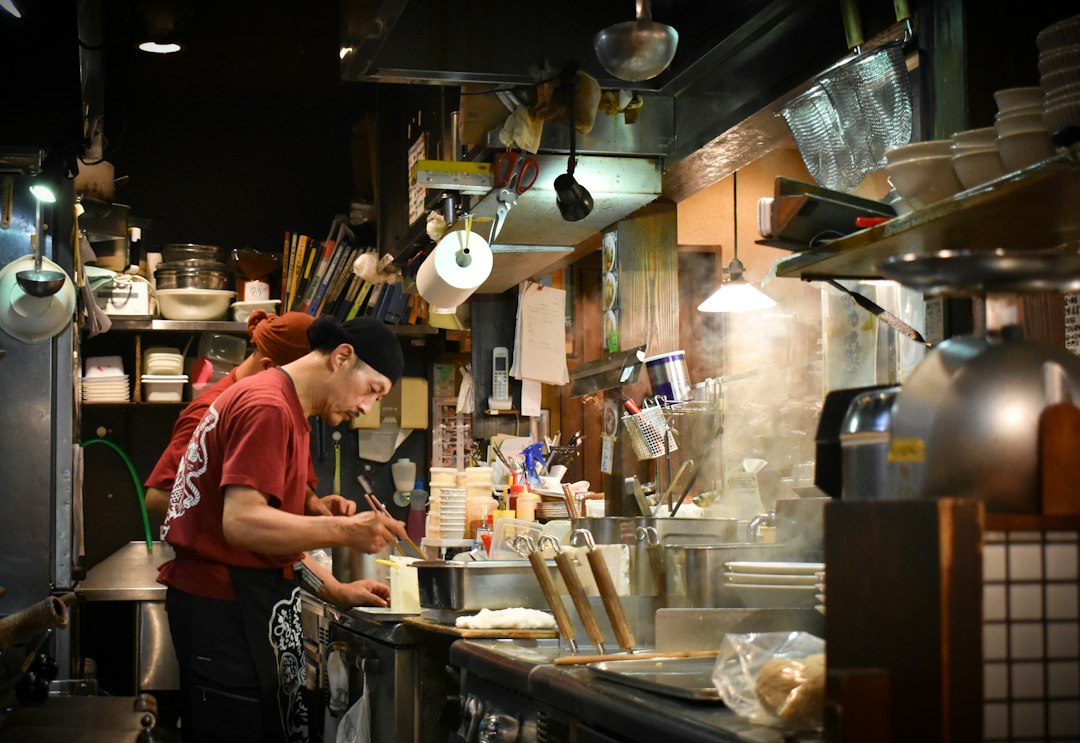
If you only have time for one bowl in Yokohama, go to Yoshimuraya (吉村家) in Shinsugita. It’s a one-minute walk from Shinsugita Station on the Keikyu Main Line, about eight minutes by local train from Yokohama Station, and it’s the shop that started the entire ie-kei style back in 1974. The line still forms before the 11:00 opening most days, it closes some Mondays and occasional Tuesdays without much online notice, and a regular bowl runs around ¥850-950 with chashu-men closer to ¥1,150. Everything else in this guide radiates out from that one counter.
What Actually Makes Ie-kei Ramen Different
Ie-kei (家系, literally “house lineage”) is a pork-bone broth blended with a soy sauce tare, finished with chicken fat so the surface shimmers with an oily sheen. The noodles are thick, flat, and straight — closer to what you’d find in Tokyo shoyu ramen than the thin curly noodles of Kyushu tonkotsu. Every proper bowl comes with the same three toppings: a sheet of nori, a mound of boiled spinach (hourensou), and at least one slice of chashu. The nori isn’t decorative — you’re meant to wrap it around a scoop of rice and dunk it in the broth near the end of the meal. That’s also why so many ie-kei shops sell a small bowl of plain rice for ¥100-150, or throw it in free with the chashu-men.
The Birthplace: Yoshimuraya in Shinsugita
Founder Yoshimura Minoru opened the original shop in Yokohama’s Isogo Ward in 1974, and the current location still uses the same base recipe his disciples spread across the country. Hours run roughly 11:00–15:00 and 17:00–22:00 with a midday break, and the shop is cash-based with a ticket machine (shokkenki) at the entrance — the buttons are Japanese only, so knowing the kanji for ramen (ラーメン, written in katakana actually) and chashu-men (チャーシュー麺) before you go saves a lot of pointing at pictures. Because this is considered the “honke” (original house), portions and seasoning are treated almost as a benchmark against which every other shop in the genre gets compared by regulars.
The Family Tree: Why So Many Shops End in “-ya” or “-ke”
Ie-kei isn’t one restaurant group, it’s a lineage system. Yoshimura trained disciples who went on to open their own shops, often naming them with a surname plus 家 (ya/ke), and those disciples trained their own disciples in turn. Trade estimates put the number of shops nationwide using the ie-kei method — direct lineage or independently inspired — somewhere north of 700. In Yokohama itself, the names worth knowing besides Yoshimuraya are Rokkakuya (六角家) near Sakuragicho Station in the Noge nightlife district, Honmokuya (本牧家) out in the Honmoku area, and Musashiya (武蔵家), whose main shop sits near Totsuka Station on the JR Tokaido Line about 15 minutes south of Yokohama Station. Each branch tweaks the tare’s saltiness or the broth’s fat content slightly, which is exactly why ie-kei fans in Yokohama argue about “their” shop the way people argue about regional barbecue.
How to Order Like a Local
At the ticket machine, buy your base ramen first, then when you hand the ticket to staff they’ll usually ask three questions in rapid Japanese about customization. You can answer with three words:
- Noodle firmness (麺の硬さ): futsuu (normal), katame (firm), or barikata (very firm)
- Broth richness (スープの濃さ): futsuu, or koime (stronger, saltier)
- Oil amount (油の量): futsuu, or oomé (more oil, more chicken fat on the surface)
First-timers should just say “futsuu” for all three — the default is already fairly rich by Tokyo ramen standards. Most counters also have a self-serve condiment tray with rayu (chili oil), raw garlic press, and pickled ginger; using them is completely normal, not a faux pas.
Best Neighborhoods for an Ie-kei Crawl
Yokohama Station’s west exit (Nishiguchi) area has the highest shop density if you want to compare two or three bowls in one afternoon, since several lineages have outposts within a ten-minute walk of the station’s Sotetsu and JR exits. For a more local, less tourist-traffic experience, head to Noge near Sakuragicho Station — it’s a narrow entertainment district with izakayas and late-night ramen counters that stay open well past midnight, useful if you’re doing the touristy Minato Mirai waterfront walk earlier and want dinner after dark. Totsuka, about 20 minutes south of central Yokohama on the JR Tokaido Line, is worth the trip specifically for Musashiya’s main shop if you want to see where one of the biggest branch families actually started.
Ie-kei vs. the Shin-Yokohama Ramen Museum — Don’t Confuse the Two
A lot of searches for Yokohama ramen end up at the Shin-Yokohama Ramen Museum by mistake. It’s a genuinely fun basement food theme park built to look like 1958 Tokyo, located about three minutes on foot from Shin-Yokohama Station (the Shinkansen stop, not central Yokohama Station), open roughly 11:00–21:00 with last orders around 20:30 and adult admission near ¥500. But it features ramen shops from all over Japan — Hakata tonkotsu, Sapporo miso, Kitakata shoyu — served in half-size portions so you can try several, and ie-kei is only occasionally represented there. If your goal is specifically the Yokohama-born pork-soy style, skip the museum and go to the actual neighborhood shops listed above.
Practical Tips Before You Go
- Bring cash. IC cards (Suica/PASMO) are spreading but plenty of ie-kei counters, including some Shinsugita-area shops, are still cash-only.
- Eat fast. These are counter shops built for turnover, especially at lunch — lingering with your phone while a line forms outside is noticed.
- Ask about the free rice refill. Many shops offer unlimited plain rice at lunch (gohan muryou) specifically meant to be eaten with the leftover broth and a raw egg (tamago), which you can usually add for ¥50-100.
- Portion sizes run large. A “futsuu” (regular) bowl here is often heavier than a regular bowl of Hakata tonkotsu, so think twice before ordering the extra-large (tokumori) your first time.
One Timing Note Before You Plan the Trip
Avoid the 12:00–13:00 and 19:00–20:00 windows near Yokohama Station if you dislike queueing — those are when office workers and commuters hit the same five or six shops at once. The quiet stretch is usually 14:30–16:30 on weekdays, when several shops are still serving but the line has evaporated. Also build in a buffer around New Year’s: many of these are small, family-run counters, not chains, and it’s common for them to close for several days around January 1st with little advance notice posted anywhere except a handwritten sign taped to the door.
Photo by Anton Nazaretian on Unsplash