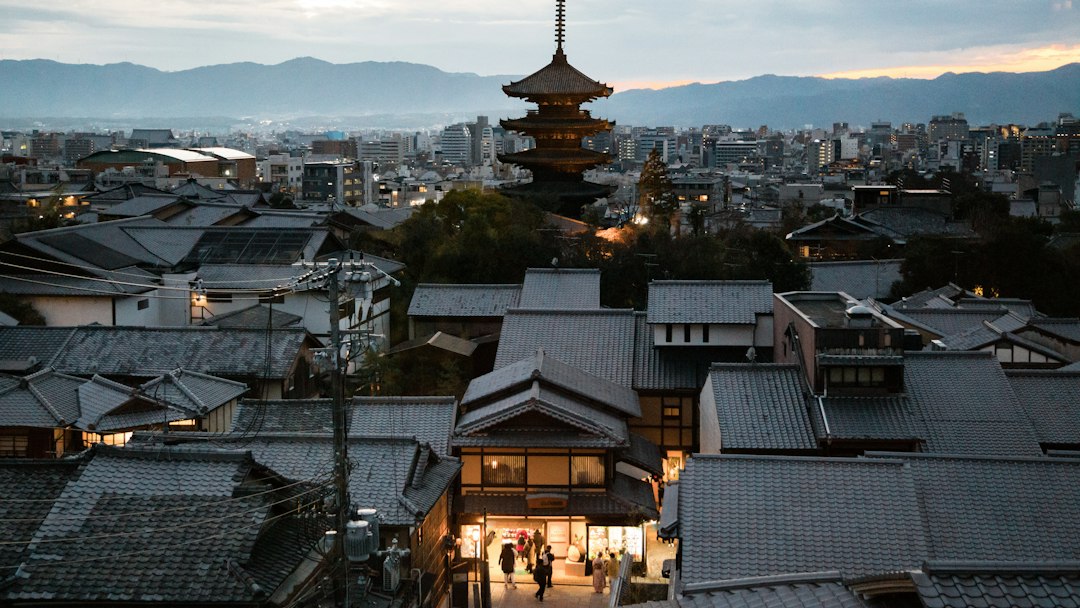
## Where Higashiyama Guesthouses Actually Sit (And Which Station to Use)\n\nMost people searching for a guesthouse stay in the Kyoto Higashiyama district picture the stone steps of Ninenzaka and Sannenzaka, but almost nothing is built directly on those slopes — the whole area is a protected townscape zone (伝統的建造物群保存地区), so new construction is restricted and most guesthouses sit in the backstreets east of Higashioji-dori, around Yasaka Shrine, Kodaiji, and down toward Gojo-zaka, the old pottery-shop street leading up to Kiyomizu-dera.\n\nThere’s no subway running through this part of Higashiyama. The Keihan Main Line is your real access point: Kiyomizu-Gojo Station puts you at the base of Gojo-zaka in about 8 minutes on foot, while Gion-Shijo Station lands you near Yasaka Shrine and the Gion-side guesthouses, roughly a 12-15 minute walk east. Coming from Kyoto Station, city bus 206 or 100 running along Higashioji-dori is usually faster than the train — stops like Higashiyama-Yasui and Kiyomizu-michi sit right inside guesthouse territory, and the flat fare is around 230 yen regardless of distance.\n\n## Guesthouse vs Ryokan vs Business Hotel: Which One Actually Fits Higashiyama\n\nHigashiyama gets marketed as a ryokan district because of Gion’s reputation, but plenty of travelers end up happier in a guesthouse here — the choice comes down to budget, how much privacy you need, and whether you can handle stairs with no elevator (common in all three categories in this neighborhood, since most buildings are converted old machiya).\n\n**Guesthouse — best for:**\n- Solo travelers and backpackers on a daily budget under 6,000 yen\n- People who want a shared kitchen/common room to meet other travelers\n- Short stays of 1-3 nights where you’ll barely be in the room anyway\n- Anyone fine with a shared bathroom down the hall\n\n**Ryokan — best for:**\n- Couples or families wanting a kaiseki dinner and private onsen-style bath included\n- Travelers who want the Gion/Higashiyama atmosphere built into the stay itself (tatami, yukata, a tsuboniwa garden view)\n- Anyone with a budget of 25,000 yen+ per night and only 1-2 nights to splurge\n\n**Business hotel — best for:**\n- Travelers who want a predictable private room with en-suite bathroom at mid-range price\n- Those prioritizing proximity to a train line over atmosphere\n- People traveling with a lot of luggage who don’t want to drag it up a slope\n\n| Item | Guesthouse | Ryokan | Business Hotel |\n|——|———–|––––|—————–|\n| Price range (per night) | ¥3,000-4,500 dorm / ¥8,000-15,000 private | ¥20,000-50,000+ | ¥10,000-20,000 |\n| Privacy | Low (dorm) to medium (private room, shared bath) | High | High |\n| Bathroom | Usually shared | Often private or reserved-slot shared bath | Always private, en-suite |\n| Typical Higashiyama location | Backstreets off Higashioji-dori, Yasaka/Kodaiji area, Gojo-zaka | Gion, Maruyama Park edge, near Hanamikoji | Sanjo-Keihan edge, closer to Kawaramachi |\n| Luggage-friendliness | Poor — stairs, no elevator, narrow entries | Poor to moderate — staff often help carry | Good — mostly ground-level or elevator access |\n| Best for | Solo travelers, budget trips, short stays | Couples, special-occasion stays | Families, business travelers, convenience-first |\n\nIf you’ve compared the numbers above and the guesthouse route makes sense for your trip, it’s worth checking current availability now rather than later — Higashiyama has a small total room count compared to central Kyoto because of the building restrictions, and beds near Kiyomizu-dera and Gion sell out fast for cherry blossom and autumn foliage weeks. **Check current rates and open dates for Higashiyama guesthouses before the dates you want disappear.**\n\n## What a Night at a Higashiyama Guesthouse Actually Costs and Looks Like\n\nTani House, a long-running backpacker guesthouse tucked behind Kennin-ji temple near Yasaka-dori, is a useful reference point because it’s been operating since the 1980s and hasn’t changed its basic model: tatami dorm beds run around ¥3,000-3,500 a night, private tatami-style rooms for two go for roughly ¥7,000-9,000, and there’s a communal kitchen where guests actually cook rather than just microwave convenience store food. The bathroom is shared, hot water isn’t unlimited during peak check-in hours (6-9pm), and the front door has a code rather than 24-hour staff.\n\nAt the other end, newer design-forward guesthouses closer to Kiyomizu-michi offer private en-suite rooms with their own shower and toilet for ¥12,000-18,000 for two people — still technically a guesthouse (shared lounge, often no in-room TV, sometimes a shared washing machine), but with the privacy of a hotel room. Breakfast is rarely included in either tier; expect to walk to a nearby café or convenience store instead.\n\n## Picking a Pocket of Higashiyama: Gion Side vs Kiyomizu Side vs Sanjo-Keihan Edge\n\n**Gion / Yasaka Shrine side** — guesthouses on the small lanes off Hanamikoji and around Yasaka Shrine put you closest to evening atmosphere; this is where you might spot a geiko or maiko heading to an appointment around 5:30-6:30pm near the shrine’s southern gate. It’s also the noisiest after dark on weekends, with izakaya traffic along Shijo-dori spilling into the backstreets until around 11pm.\n\n**Kiyomizu / Gojo-zaka side** — guesthouses near the pottery street (shops here generally open 10am-5pm, many closed Wednesdays) put you a 10-15 minute uphill walk from Kiyomizu-dera itself. This stretch is quieter at night but the walk back from dinner downtown involves a real incline, which matters more than it sounds like after a full day of sightseeing.\n\n**Sanjo-Keihan edge** — a handful of guesthouses sit closer to Sanjo, trading some of the old-town feel for a flatter, shorter walk to Pontocho and Kawaramachi, plus faster Keihan Line access north toward Demachiyanagi or south toward Fushimi Inari (about 15 minutes by train). This is the better pick if your itinerary is split between Higashiyama and downtown Kyoto nightlife.\n\n## Practical Things Nobody Mentions\n\n- A hard-shell suitcase with wheels is a bad match for Sannenzaka and Ninenzaka’s uneven stone paving — a soft duffel or backpack saves your wrists and the guesthouse floor.\n- Kiyomizu-dera opens at 6am; staying within the Higashiyama/Gojo-zaka pocket means you can walk up before 7am and see the main hall without the 9am-onward tour bus crowds.\n- Convenience stores are sparser than you’d expect inside the preserved townscape zone because of sign and storefront restrictions — the nearest Lawson or FamilyMart to many guesthouses is a 5-10 minute walk, usually out on Higashioji-dori.\n- Machiya construction means thin walls and creaky floors; if you’re a light sleeper, ask at booking for a room away from the common lounge or kitchen.\n- Almost none of these buildings have an elevator. If stairs are a genuine problem, a business hotel near Keihan Sanjo or Shijo will serve you better than any guesthouse in this district.\n\n## FAQ\n\n**Is a Higashiyama guesthouse walkable to both Kiyomizu-dera and Gion?** Yes — most sit somewhere between the two, with walking times of 10-20 minutes to either landmark depending on exactly which backstreet you’re on.\n\n**Do Higashiyama guesthouses have a curfew?** Some of the older, family-run ones lock the front door between roughly midnight and 6am and issue a door code instead of a key; newer hostels usually don’t. Check the individual listing rather than assuming either way.\n\n**Is the area safe for solo travelers at night?** Yes on the main streets, which are well lit until late; the narrow residential lanes behind Yasaka Shrine get genuinely dark after 10pm, so it’s worth noting your guesthouse’s exact lane in daylight before relying on a map at night.\n\nOne last thing worth knowing before you book: Google Maps and some booking sites will round a Higashiyama address to a flat walking time that ignores the slope. A listing that says \“12 minutes to Kiyomizu-dera\” might be accurate in distance but closer to 18-20 minutes once you factor in the uphill stretch on Gojo-zaka or Chawanzaka — build that buffer into your schedule, especially if you’re arriving with luggage straight from the station.
Photo by Daisy Chen on Unsplash